

ADHD Emotional Dysregulation in Women: Why You Feel Everything So Deeply

Has anyone ever told you that you are too sensitive? Too dramatic? Too intense? That you take things too personally, that you overreact, that you care too much?
If you grew up hearing those words, and you also happen to have ADHD, there is a good chance that what others labelled as a personality flaw was actually your nervous system doing exactly what it is wired to do. You were not too much. You were undiagnosed, unsupported, and doing the best you could with a brain that processes emotion differently from the people around you.
This is one of the most overlooked conversations in ADHD care, and it is one I have regularly with the women who walk through my door.
Emotional dysregulation is increasingly recognised as a core feature of ADHD, particularly in women. Many women with ADHD experience intense emotional reactions, rejection sensitivity, overwhelm, masking, and emotional exhaustion that are often misunderstood as personality flaws, anxiety, or “being too sensitive.” Research now suggests these emotional experiences are closely linked to ADHD-related differences in executive functioning, dopamine regulation, and nervous system processing.

The Emotional Life of ADHD Is Not a Side Effect
For decades, the public understanding of ADHD was built almost entirely around the hyperactive young boy who could not sit still in class. Attention, impulsivity, and behaviour were the focus. Emotion barely got a mention.
But research has steadily been dismantling that narrow picture. A growing body of evidence now supports what many clinicians and people with lived experience have known for years: emotional dysregulation is not a side effect of ADHD. For many people, it is one of its most defining and disabling features.
A 2025 controlled study of 176 adult women found that emotional dysregulation was directly associated with ADHD symptom severity and executive function deficits. Women with ADHD showed significantly greater difficulty regulating their emotional responses compared to women without ADHD, and were more likely to rely on maladaptive strategies such as emotional avoidance and an inability to identify or describe their own feelings. The researchers concluded that emotional dysregulation should be understood as a core component of ADHD, not a secondary complication (Slobodin et al., 2025).
That is not a small finding. It changes the entire frame.
Why the ADHD Brain Struggles with Emotional Regulation
To understand why emotion feels so amplified in ADHD, it helps to know a little about what is happening beneath the surface.
The ADHD brain shows differences in the prefrontal cortex, which is responsible for executive functions including the ability to pause, reflect, and modulate emotional responses. When the brain encounters an emotional trigger, the prefrontal cortex is meant to step in, slow things down, and help regulate the intensity of the response. In ADHD, this process is less efficient. The emotional signal fires, but the braking system takes longer to engage or does not engage fully at all.
What this means in practice is that emotions arrive at full intensity before there is any capacity to soften them. It is not that women with ADHD choose to overreact. It is that by the time the thinking brain catches up, the emotional experience has already taken hold.
This is sometimes called emotional flooding, and it is exhausting. Not just for the people around you, but for you.
You may have spent years believing you were “too emotional” when in reality your nervous system was overloaded and unsupported.
You might like to read about ADHD burnout in women
Many women also describe experiencing cycles of exhaustion and shutdown after prolonged emotional overwhelm, something I explore further in my article on ADHD burnout in women.
Rejection Sensitivity: When Perceived Criticism Feels Like a Wound
One of the most talked about and under-researched aspects of emotional life in ADHD is rejection sensitive dysphoria, or RSD.
Psychiatrist William Dodson, who has spent decades working with adults with ADHD, describes RSD as triggered by the perception, real or imagined, of being criticised, teased, rejected, or of falling short of your own or others' expectations. He estimates that a significant majority of people with ADHD experience this at some point in their lives, and that around one third describe it as the most difficult aspect of living with ADHD (Dodson, 2016; CHADD, 2019).
The word dysphoria is important here. It means difficult or impossible to bear.
This is not sensitivity in the ordinary sense of the word.
People with RSD describe the experience as a physical sensation, something akin to being punched in the chest. The pain is real, immediate, and often disproportionate to the triggering event in ways that are confusing even to the person experiencing it.
A 2023 qualitative study found that most adults with ADHD reported their diagnostic criteria did not accurately capture their experience, and that roughly 77% described struggling with rejection sensitivity despite it not appearing in formal diagnostic criteria. Notably, the sample was predominantly female (Holbrook et al., 2023).
The relational consequences of this are significant.
Women with RSD may become hypervigilant to social cues, reading tone of voice, facial expressions, and silences for signs of disapproval. They may over-explain, apologise excessively, avoid conflict to the point of self-erasure, or pull back from relationships entirely to protect themselves from anticipated pain.
On the surface this can look like anxiety, people-pleasing, or emotional immaturity.
Underneath it is a nervous system on permanent alert.
Masking: The Invisible Labour of Holding It Together
Women are socialised to manage their emotions quietly. To be agreeable, relatable, and composed. For women with ADHD, this social expectation collides with a neurology that makes emotional regulation genuinely difficult, and the result is masking.
Masking is the ongoing, often unconscious effort to suppress or disguise ADHD symptoms in order to appear neurotypical.
In the emotional domain, this often looks like:
swallowing frustration and crying in private
maintaining a calm exterior at work while internally overwhelmed
laughing along when you are actually hurt
rehearsing conversations obsessively to avoid saying the wrong thing
In my counselling work with women on the Sunshine Coast, these themes come up constantly.
Masking is not a choice so much as a survival strategy developed over years of receiving the message that your authentic reactions are too much. But it comes at an enormous cost.
Research consistently links chronic masking in women with ADHD to fatigue, burnout, imposter syndrome, anxiety, depression, and profoundly low self-worth.
A large UK survey found that half of neurodivergent employees were burnt out, compared with 38 percent of neurotypical workers (WTW, as cited in West, 2025).
The emotional, cognitive, and physical labour of performing neurotypicality has been compared to holding down multiple jobs simultaneously, except the exhaustion follows you home and does not clock off (ADDitude Magazine, 2024).
Because masking is so effective, women with ADHD are frequently missed by teachers, doctors, and mental health professionals. What they tend to see instead is anxiety, depression, or emotional dysregulation of unclear origin.
The underlying cause goes unrecognised, often for decades.
To learn more about late diagnosed ADHD you might like to read about grief and late diagnosis ADHD
When Hormones Make Everything Harder
There is another layer to this conversation that is only now beginning to receive the attention it deserves: the relationship between ADHD, hormonal fluctuations, and emotional regulation.
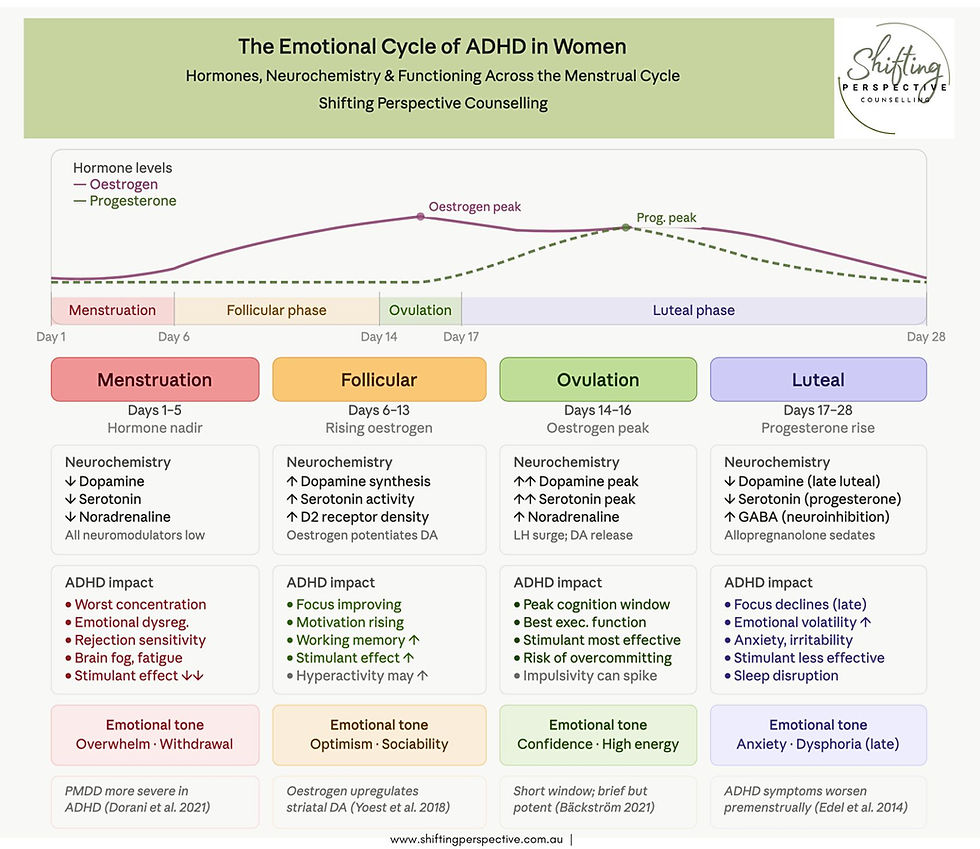
Oestrogen plays a significant role in regulating dopamine and serotonin, the same neurotransmitters that are already dysregulated in ADHD.
Research has demonstrated that oestrogen increases dopamine synthesis and receptor activity, particularly in the prefrontal cortex and basal ganglia, regions central to attention and emotional regulation (Bendis et al., as cited in PMC, 2025).
When oestrogen drops, as it does in the days before menstruation, after giving birth, and throughout perimenopause, dopamine availability falls with it.
For a brain already operating with a dopamine deficit, this hormonal withdrawal can feel catastrophic. This helps explain why so many women with ADHD describe a significant worsening of their symptoms in the lead-up to their period.
The emotional reactivity intensifies.The rejection sensitivity spikes.The ability to hold themselves together under pressure narrows.Tasks that were manageable suddenly feel impossible.
For some women, this experience meets clinical criteria for Premenstrual Dysphoric Disorder, or PMDD.
The overlap between ADHD and PMDD is striking: research suggests that around 45 percent of women with ADHD also experience PMDD, a rate far exceeding the general population (Dorani et al., 2021).
A large ADDitude survey found that 66 percent of women with ADHD reported experiencing PMS or PMDD, with emotional symptoms, not physical ones, rated as most debilitating (ADDitude, 2024).
Hormonal shifts during perimenopause can intensify ADHD symptoms significantly, particularly emotional regulation and cognitive overwhelm.
If you'd like to learn more about ADHD and perimenopause read ADHD and Perimenopause: Why Symptoms Get Worse
When ADHD and PMDD coexist, emotional dysregulation can become genuinely difficult to manage. Irritability shades into rage. Sadness becomes a shutdown. The masking strategies that usually work stop working entirely.
Without an understanding of the neurobiological picture underneath, it is very easy to internalise all of this as evidence that something is fundamentally wrong with you as a person.
Nothing is fundamentally wrong with you.
You have a sensitive nervous system that is being hit from multiple directions at once.
When Relationships Become Painful
The emotional world of unrecognised ADHD plays out in relationships in ways that are often deeply painful and hard to name.
Fear of rejection means that conflict, even minor misunderstandings, can feel like abandonment.
Emotional flooding means that things come out in the heat of the moment that are not representative of what you actually think or feel.
The aftermath, the shame spiral, the frantic attempts to repair and over-explain, can be just as destabilising as the original rupture.
Many women with ADHD describe the exhaustion of feeling like too much for the people they love. They work constantly to regulate themselves, to soften their edges, to take up less emotional space.
And when they inevitably fall short of that standard, the internal critic arrives.
Why can I not just control myself?Why do I care so much?Why did I say that?What is wrong with me?
This cycle, emotional intensity followed by shame, followed by over-functioning, followed by eventual collapse, is one of the most common patterns I see in practice.
And it is almost never identified for what it is until someone starts asking the right questions.
The Grief That Lives Underneath
Here is the piece that rarely gets talked about in ADHD spaces, and that I think is one of the most important.
Many women carry a profound grief about who they might have been if they had known sooner.
They grieve:
the friendships that fell apart
the opportunities they could not sustain
the years spent believing they were lazy or difficult
the exhaustion of constantly trying to “fix” themselves
the younger version of themselves who never understood why life felt harder
A 2025 study published in Scientific Reports surveyed women with late-diagnosed ADHD and found that participants commonly internalised criticism, reported significantly low self-esteem, and described guilt, shame, and negative self-perception that had accumulated over years without explanation or support (Young et al., 2025).
A separate 2025 qualitative study found that late-diagnosed women experienced feelings of anger, sadness, and grief as common responses to diagnosis, alongside validation and relief. Participants described reflecting on “what could have been” and grieving the lives they might have led with earlier support (Bradbury & Sherwood, 2025).
This is real grief.
It deserves to be treated as such.
If you'd like to learn more about grief counselling visit Grief and Loss Counselling.
Receiving a diagnosis does not automatically undo decades of self-blame.
For many women, it opens a door into a much older wound:
the small girl who tried so hard and still could not get it right
the teenager who was called dramatic
the adult who has spent years quietly convinced that she is too much to be truly loved
Processing that history, with compassion and with the right support, is where a lot of the real work lives.
What This Means for How We Seek Support
If you recognise yourself in any of what you have read here, a few things are worth knowing.
You are not broken.
Emotional intensity in ADHD is neurological, not a character flaw, and not evidence of weakness.
The brain you have processes emotion more rapidly and more intensely than a neurotypical brain, and without the same automatic braking system.
That is worth understanding, not pathologising.
The emotional symptoms matter as much as the attention symptoms.
If you are seeking an assessment, or speaking to a health professional, bring your emotional experiences into the conversation.
Talk about:
rejection sensitivity
emotional flooding
emotional shutdown
masking
burnout
nervous system overwhelm
These are legitimate clinical features and they deserve to be part of the picture.
Hormonal patterns are worth tracking.
If you notice significant worsening of emotional regulation at particular points in your cycle, or if perimenopause has changed the way your ADHD feels, bring that information to your doctor or psychiatrist.
The hormonal dimension of ADHD in women is increasingly well-supported by research and increasingly relevant to treatment planning.
Grief is part of the process.
For women who receive a late diagnosis, or who are only now beginning to understand their history through this lens, the emotional aftermath can be significant.
Feeling angry, sad, or lost in that process is not a sign that something has gone wrong.
It is often a sign that something important is finally being seen.
Counselling can help.
Not because there is something wrong with you, but because these experiences are layered, exhausting, and deeply personal.
Working with someone who understands the intersection of ADHD, emotional regulation, grief, burnout, and nervous system overwhelm can make a significant difference to how you move through this.
If you'd like support working with an adhd diagnosis or suspect you're ADHD, ADHD Counselling and Coaching might be a good fit.
A Final Word
You were never too much.
You were a woman with a brain that felt things intensely, without the roadmap to understand why or the support to navigate it.
You did what you had to do to get through.
And now, perhaps for the first time, you are starting to understand what was actually happening.
That understanding matters.
And so do you.
ADHD Counselling Support on the Sunshine Coast
If this article felt painfully familiar, you are not alone.
Emotional intensity in ADHD can be exhausting, confusing, and deeply isolating, especially for women who have spent years masking or blaming themselves.
Counselling can help you better understand your nervous system, emotional patterns, relationship dynamics, and the grief that often sits underneath late recognition and burnout.
I offer ADHD counselling support and coaching for teens and adults online across Australia and in-person on the Sunshine Coast.
Book a free 10-minute call to see if we're a good fit.
FAQ Section
Is emotional dysregulation part of ADHD?
Yes. Research increasingly suggests that emotional dysregulation is a core feature of ADHD for many people, particularly women. Emotional intensity, overwhelm, rejection sensitivity, and difficulty regulating reactions are common experiences in ADHD.
Why do women with ADHD feel emotions so intensely?
ADHD affects executive functioning and emotional regulation pathways in the brain. This can make emotional responses feel immediate, overwhelming, and difficult to regulate before the nervous system becomes flooded.
What is rejection sensitive dysphoria (RSD)?
Rejection sensitive dysphoria, often called RSD, refers to intense emotional pain triggered by perceived criticism, rejection, or failure. Many adults with ADHD describe this as one of the most distressing parts of living with ADHD.
Can hormones make ADHD symptoms worse?
Yes. Hormonal fluctuations involving oestrogen can significantly affect dopamine regulation, emotional regulation, focus, and overwhelm in women with ADHD, particularly during PMS, PMDD, postpartum periods, and perimenopause.
Can counselling help with emotional regulation in ADHD?
Counselling can help people better understand emotional patterns, nervous system overwhelm, masking, shame, burnout, and relationship difficulties associated with ADHD. Support may also help process grief related to late diagnosis and years of self-blame.
References
Bradbury, S., & Sherwood, M. (2025). 'I felt like a broken person': The experiences of women navigating a late ADHD diagnosis in the UK. Journal of Neurodevelopmental Conditions. https://doi.org/10.1080/18387357.2025.2524513
CHADD (Children and Adults with Attention-Deficit/Hyperactivity Disorder). (2019). Rejection can be more painful with ADHD. https://chadd.org/adhd-weekly/rejection-can-more-painful-with-adhd/
Dodson, W. W. (2016). Emotional regulation and rejection sensitivity. Attention Magazine, 8–11.
Dorani, F., Bijlenga, D., Beekman, A. T. F., van Someren, E. J. W., & Kooij, J. J. S. (2021). Prevalence of hormone-related mood disorder symptoms in women with ADHD. Journal of Psychiatric Research, 133, 10–15. https://doi.org/10.1016/j.jpsychires.2020.12.005
French, B., Daley, D., Groom, M., & Cassidy, S. (2024). Review: Mental health, physical health, and social and lifestyle outcomes in women with ADHD. Frontiers in Psychiatry. https://doi.org/10.3389/fpsyt.2024.1447958
Holbrook, J. R., Bitsko, R. H., Danielson, M. L., & Visser, S. N. (2023). “Dysregulated not deficit”: A qualitative study on symptomatology of ADHD in young adults. https://pmc.ncbi.nlm.nih.gov/articles/PMC10569543/
Lin, P-C., Long, C-Y., Ko, C-H., & Yen, J-Y. (2024). Comorbid attention deficit hyperactivity disorder in women with premenstrual dysphoric disorder. Journal of Women's Health. https://doi.org/10.1089/jwh.2023.0907
Modestino, E. J., et al. (2024). Rejection sensitivity dysphoria in attention-deficit/hyperactivity disorder: A case series.Acta Scientific Neurology, 7(8), 23–30.
Slobodin, O., Har Sinay, M., Zohar, A. H., & Chen, L. H. (2025). A controlled study of emotional dysfunction in adult women with ADHD. PLOS ONE. https://doi.org/10.1371/journal.pone.0337454
Turjeman-Levi, Y., Itzchakov, G., & Engel-Yeger, B. (2024). Executive function deficits mediate the relationship between employees' ADHD and job burnout. AIMS Public Health, 11(1), 294–314.
Young, S., Adamo, N., Ásgeirsdóttir, B. B., Branney, P., Beckett, M., Colley, W., & Gudjonsson, G. (2025). Adverse experiences of women with undiagnosed ADHD and the invaluable role of diagnosis. Scientific Reports. https://doi.org/10.1038/s41598-025-04782-y
Zourikian, N., et al. (2025). ADHD and sex hormones in females: A systematic review.https://pmc.ncbi.nlm.nih.gov/articles/PMC12145478/

Kimberly Freeman, BA Psychology, Dip Counselling, Registered Counsellor is the founder of Shifting Perspective Counselling, based on the Sunshine Coast, Australia. She offers compassionate, client-centred support for those navigating grief, loss, and life transitions both in person and via telehealth Australia wide.



Comments